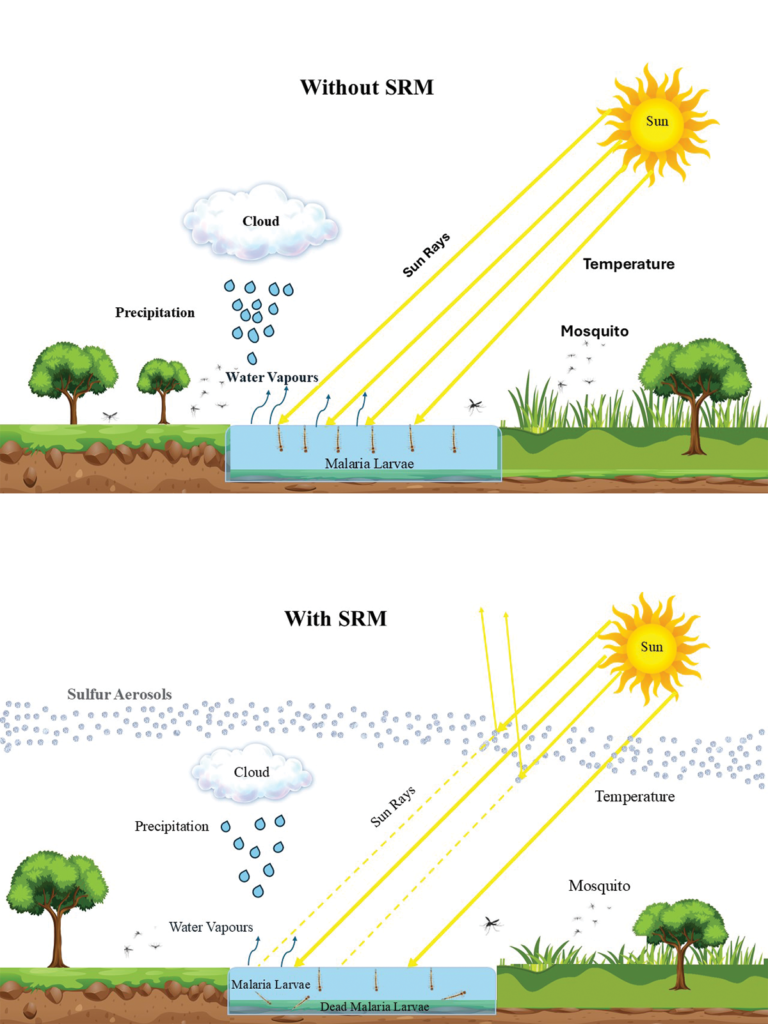
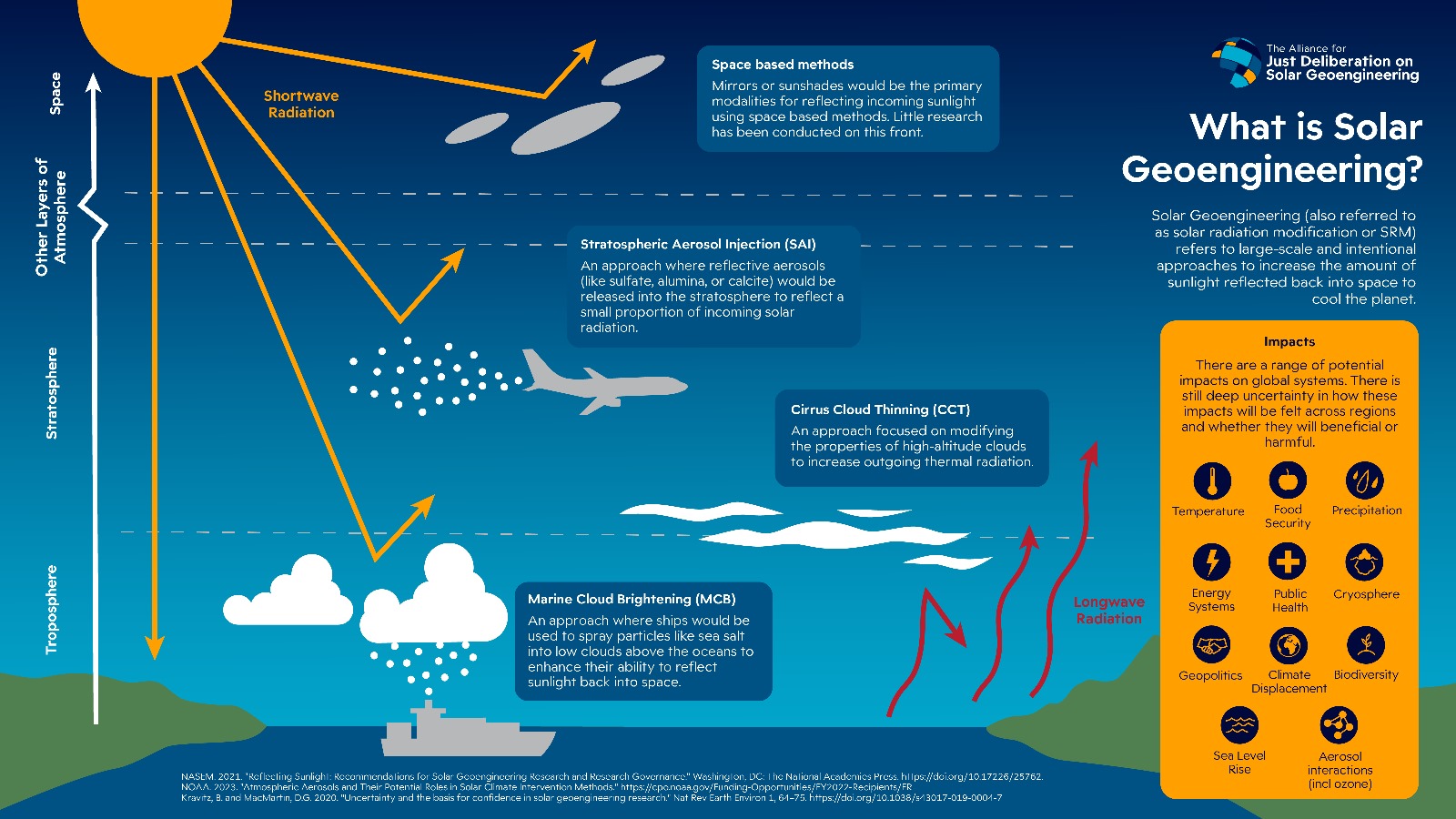
Climate change is happening, and it is human-induced. According to the Intergovernmental Panel on Climate Change (IPCC) Sixth Assessment Report, the global mean surface temperature was about 1.1°C higher from 2011 to 2020 compared to the pre-industrial period (1850–1900). This warming is unequivocally attributed to human activities, including fossil fuel combustion, deforestation, and livestock farming. These changes are expected to have numerous negative and, in some cases, irreversible effects on both human society and natural ecosystems, especially for the Global South countries – like all those in South Asia. Solar Radiation Modification (SRM), or solar geoengineering, encompasses various approaches aimed at reflecting a small amount of sunlight back into space in order to rapidly bring down the global average temperature. It must be emphasized that scientists and policy makers know very little about the impact of deployment of SRM technologies on many other important aspects; for example, little is known about the impact of these technologies on precipitation, agriculture/food security, water availability, sea level rise, polar ice loss, economics, geopolitics, and many other dimensions. Further, although the global average temperature does go down under certain SRM deployment scenarios, regional changes to temperature (and other climate variables) is diverse and remains ill understood. Primarily SRM approaches currently considered technically and economically feasible include marine cloud brightening (MCB) and Stratospheric Aerosol Injection (SAI).
For the purposes of the SRM Malaria Dashboard, we focus on SAI, which is the most widely studied and simulated SRM technology. Major volcanic eruptions, such as Mount Pinatubo in 1991, which released large amounts of sulfate particles into the stratosphere, offer a natural example of SAI effects. The eruption led to a global annual mean cooling of about 0.3–0.5°C over the following two years. Climate modeling experiment GeoMIP simulated a similar injection of sulfur into the stratosphere to determine how various climate variables might change, including temperature and precipitation. Our work takes that assessment one step further, and sees how, where and how much malaria transmission might change as a result of various sulfur injections in the stratosphere. Here, we present those results in the form a dashboard that can elucidate the dimensions of climate and health for policymakers in an easy to understand format.